Teeth whitening is one of the most-searched dental treatments in the Philippines — and one of the most misunderstood. Does it thin your enamel? Why do some people get sensitivity? Is the in-office session really worth more than a take-home kit, and why do supermarket strips underperform? Let's clear things up.
Does teeth whitening damage your teeth?
Professional whitening, done or supervised by a dentist, is safe for healthy teeth. The whitening gel (hydrogen or carbamide peroxide) passes through the enamel and breaks down the stain molecules inside the tooth; it doesn't strip or thin the enamel, which remineralises naturally from saliva afterwards. What is risky is unsupervised use of harsh or counterfeit products, over-use of high-strength gels, and whitening over untreated cavities or gum disease, which is why we examine first. Decades of clinical use show no lasting damage to enamel from properly supervised whitening.
A real whitening result
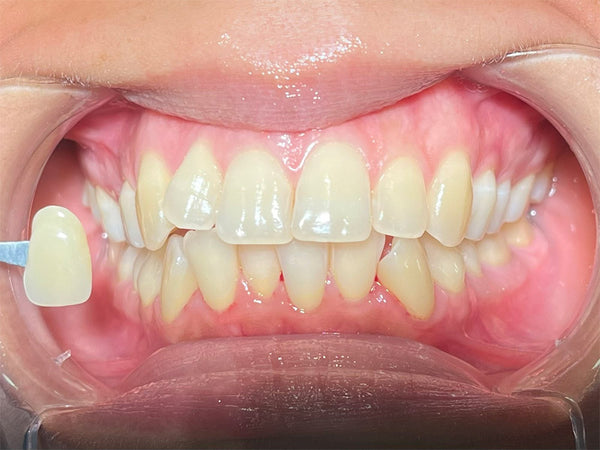

Real Modern Smiles patient, photo shared with permission. Individual results vary.
Why do teeth feel sensitive after whitening?
Some temporary sensitivity is normal for a day or two after in-office whitening. The peroxide briefly makes the tooth more permeable, so cold air and drinks reach the nerve more easily until the enamel settles. It fades on its own. Your dentist can apply a desensitising gel after the session and recommend a desensitising toothpaste for the week before and after, which makes a real difference. If you already have sensitive teeth, say so — we can lower the gel strength or recommend the slower take-home route.
In-office vs take-home whitening: which should you choose?
- In-office whitening (starts at ₱13,500 at Modern Smiles) delivers a noticeable shade jump in a single 60–90 minute visit. Gums are protected with a barrier, a stronger gel is applied in cycles, and you walk out with the result. Popular before weddings, graduations and big events.
- Take-home kits (start at ₱7,500) use custom trays made from impressions of your teeth and a dentist-supervised gel worn for a set time daily over one to two weeks. More gradual, more affordable, often gentler on sensitive teeth, and the trays can be reused for touch-ups later.
Many patients get the best result from both: an in-office session for the initial lift, then take-home trays to maintain it. Smile Savers members get 50% off in-office whitening. Guide prices last reviewed October 2026.
Why do supermarket whitening strips and kits underperform?
Over-the-counter products are limited by law to low peroxide concentrations, so the change is modest and slow. One-size strips don't reach between teeth or along the gumline evenly, which can leave a patchy result, and the gel often leaks onto gums and irritates them. Charcoal powders and "whitening" toothpastes work by abrasion, which removes surface stain but can roughen enamel over time and does nothing for the colour inside the tooth. A professional take-home kit costs more but uses custom trays and a calibrated gel, which is why the result is both stronger and more even.
How long does teeth whitening last?
It depends on your habits. Coffee, tea, red wine, soy sauce, and smoking re-stain teeth faster; in the Philippines, daily kape and milk tea are the usual culprits. Most patients hold a good result for one to two years with occasional touch-ups and regular cleanings. Drinking staining drinks through a straw, rinsing with water afterwards and avoiding dark drinks for the first 48 hours after whitening all help.
When is whitening not the answer?
Whitening brightens natural enamel, but it won't change tooth shape or size, close gaps, or cover deep intrinsic stains (such as grey banding from childhood antibiotics). It also won't whiten crowns, veneers or fillings, so if you have visible restorations at the front they may need replacing to match afterwards. For those cases, veneers may be the better path — a consultation will tell you quickly which route fits your goals.
Common questions
Who should not whiten?
We don't whiten during pregnancy or breastfeeding, under 16, or over untreated cavities or gum disease. Those are treated first.
Can I whiten if I have braces?
Wait until the braces come off; otherwise you'll have pale squares where the brackets were. Aligner wearers can often whiten using their aligner trays.
How white will my teeth get?
Typically several shades on the dental shade guide. Teeth with yellow tones respond best; grey tones respond less. We'll show you the realistic target on the shade guide before we start.
Is it painful?
No. The session itself is comfortable; the only common after-effect is the short-lived sensitivity described above.
Explore whitening and veneers or book a smile consult in Pasig or Mandaluyong.
Written by Dr. Jordi Izzard A. Landayan, Prosthodontist · Last reviewed October 2026. Prices are Modern Smiles' published guide fees and are confirmed after clinical evaluation.